
October Surf Fishing Report: The Fall Transition Is Here
October 4th, 2026.
Although Gulf water temperatures are still holding around 85 degrees as we move into October, this is the month when things finally begin to change. From my experience, somewhere around Halloween we usually get that first legitimate cold snap of the year. That is one of the things I watch closely. Give me the first strong cold front, falling water temperatures, and a good moon phase, and I start paying very close attention to the passes. That is when the bull reds begin showing up in force.
Fort Pickens and Fort Morgan can absolutely stack up with bull reds, jack crevalle, baitfish (and surf fishermen trying to get in on it). Fishing these beaches after hours is not permitted, so your best bet is to get there early. And I mean early. You are not only trying to beat the sunrise. You are trying to beat everyone else who knows what time of year it is.
Poppers, metals, Carolina rigs with cut bait, large swimbaits and live or fresh dead bait can all produce. A lot of the time, though, the birds will tell you everything you need to know. When gulls, terns and pelicans start working hard over one area, pay attention. There is usually bait getting pushed toward the surface, and something underneath it is responsible.
Why do the bull reds show up every fall? Large adult redfish spend much of their lives in coastal and offshore waters rather than deep inside the bays. Fall is also a major spawning period for mature red drum along the northern Gulf Coast. That is one of the big reasons passes such as Pensacola Pass and Mobile Bay become so important. These passes act like funnels. You have tidal current, deep water, structure and enormous amounts of bait moving between the bays and Gulf. Mature reds can congregate around these areas during the fall spawning period while also taking advantage of the food being pushed through the passes. I would not think of it as the fish simply making a one-way migration from the Gulf into the bay (or from the bay into the Gulf). They can move back and forth around the passes and adjacent nearshore Gulf depending on tide, bait and conditions. What they are really following is opportunity. Mullet are a major player during the fall. Menhaden, pinfish, croakers, shrimp, crabs and other forage can also get caught in these tidal highways. When a school of big redfish finds a concentrated food source, the feeding can get violent in a hurry. That is also why you will often find giant jack crevalle mixed into the same general areas. Everybody is there for the same reason: food.
Pompano Season Starts Waking Up. October is also when we begin seeing increasing numbers of pompano along the beach. It will not happen every single day, especially early in the month. But start paying attention to those mornings after a temperature drop.
I have joked about this for years: If you walk outside in the morning and your truck tires and beach cart tires suddenly look a little low, you should probably go pompano fishing. Obviously low tire pressure does not make pompano bite. Cooler air simply lowers tire pressure, and that same cold front is usually cooling our shallow Gulf water. Those first drops in water temperature can be one of the biggest triggers of the fall. During the heat of summer, our nearshore Gulf water can get extremely warm. As fall progresses and those temperatures begin dropping back toward the low-to-mid 70s, the surf zone becomes much more comfortable for pompano.
There is another important piece to it: food. Pompano are looking for sand fleas, coquina clams, small crabs, shrimp and other organisms living in and around the sandbars and troughs. Cooler fall conditions can bring pompano into very shallow water when those food sources are available. That means you do not always need to cast halfway to Cuba. Some of your best fish can be sitting in two or three feet of water.
I particularly like seeing Gulf temperatures work down toward roughly 68–73 degrees. That is when the fishing can become extremely consistent. We probably will not see those numbers regularly until closer to November, but October is when the transition begins.
Fall Water Clarity and Float Colors
Fall can give us some of the prettiest Gulf water of the entire year.
The key is wind. Strong south and southeast winds can churn up the surf and reduce visibility quickly. After a front passes, however, north and northeast winds can flatten the Gulf and allow suspended sand to settle. That can produce extremely clean water along the beach.
When the water gets clear, I tend to become a little more conservative with my terminal tackle. In clear water, especially in two to four feet, I like natural or subtle float combinations such as white, sand flea colors, pink and white, or smaller profile floats.
When the water has some stain or when I am fishing slightly deeper water, brighter colors become more attractive. Orange, chartreuse, green, glow and contrasting color combinations can help fish locate the rig.
Do not overthink it, though.
Water depth matters just as much as color. In two or three feet of water, a giant double-drop rig can sometimes be more tackle than you need. A single-drop rig can keep everything compact and right in the feeding zone. If I am fishing four to six feet, a double-drop rig makes much more sense because I can cover two different levels of the water column. One bait can ride closer to the bottom while the other sits slightly higher. That gives you a better chance of figuring out exactly where the fish are feeding.

Tournament Season Is About to Get Busy
October is also preparation month because we have a lot coming up. Upper Limit will run October 29 through November 30. Together We Thrive will also be hosting a one-day tournament November 14 in Navarre, Florida. The Gulf Coast Land-Based Fishing Guide Association will be helping with that event. Then we have the big one. The Panhandle Salt Pompano Showdown will take place November 20, 21 and 22, with the weigh-in Sunday, November 22 at Panhandle Salt.
As always, our sponsors have not disappointed. We are currently working out details with G.O.A.T. Carts for a possible first-place cart donation. If everything comes together, first place would receive:
*$1,000 cash provided by OBB Floats
*A G.O.A.T. beach cart valued around $1,800
*A prize bucket loaded with products from our sponsors
That would put the total first-place cash and prize package somewhere around $4,000.
Complete rules, registration information and tournament details available on the website for Upper Limit and Pompano Showdown. You can find information for the Together We Thrive event HERE.

October Fishing Tactics
One of the biggest changes I make during the fall is that I stop leaning quite as heavily on sunrise and sunset. During summer, we are often fishing early and late simply because we are trying to beat the heat. As fall sets in, that becomes less important. There are magical stretches during both the spring and fall when a surf fisherman can catch pompano throughout the entire day. Instead of focusing exclusively on sunrise, I start looking much harder at bite activation periods. Watch the wind, the tide, water clarity, and watch for a sudden wind shift. Pay attention to incoming and outgoing water. A south wind may push bait and water toward the beach. A tide change can suddenly get fish moving. A wind shift after a front can clean up water that was unfishable the day before. Those are the windows we are looking for.
I would never disregard sunrise or sunset fishing. Those will always be productive times. But if you cannot get out there first thing in the morning during October and November, do not panic. Once the water cools, the fish can stay active well into the middle of the day.
Get Ready Now
October is the month to go through everything: respools those reels, check your braid, replace worn leaders, tie rigs, restock sinkers and floats, go through the beach cart, and get your pompano gear ready. Take some time to poke around the Panhandle Salt shop as well. It feels like we have been adding new products every week lately, and there is a lot more coming.
We also recently received an update from our leasing agent that the projected opening date for our new Panhandle Salt location is around Spring Break 2027. The new shop is going to give us substantially more room for inventory, storage and new product lines, but I am probably even more excited about what we will be able to do with the space. We are planning interactive areas for rig tying and demonstrations, a permanent podcast and content area and, yes, live bait. We are also working on a turnaround area in the parking lot that will better accommodate customers pulling larger boats.
There is a lot happening, but right now, October means one thing: the heat is finally starting to break, the bull reds are getting ready, pompano are beginning to slide back into the surf, tournament season is almost here, and some of the best land-based fishing of the year is right in front of us.
We are officially in season.

September Surf Fishing Report: Fall Is Getting Close
September 6th, 2026
We’re not out of the woods yet, but we’re getting close. September on the Gulf Coast still feels a whole lot like summer. It’s hot, the water is warm, and we’re still a ways away from that first legitimate cold front. But September is the month when we start seriously preparing for fall. You can already see the signs. There is bait everywhere in the surf right now, and with that bait comes opportunity. Spanish mackerel, bluefish, redfish, sharks, jacks and even a few rolling tarpon have been showing themselves over the past week.
The fall transition is beginning. Around here, Halloween is usually when I start looking for that first substantial cold snap. One cold night isn’t necessarily going to drop the Gulf temperature dramatically, but it gets the process started. Until then, September gives us something different: warm water loaded with bait and predators. And that can make for some incredibly fun fishing.
September Is Lure-Casting Month. If you’re heading to the beach this month, bring some lures. Seriously.
There are too many opportunities presenting themselves right now to leave the lure rod at home. You could be casting into a school of bluefish to your right and suddenly see a big wake of redfish barreling toward you from the east. Spanish can erupt on bait without much warning. Jacks can show up. A tarpon might start rolling within casting distance. Everything is chasing mullet, and sometimes you can literally watch the entire food chain unfold in front of you.
My September lure setup is pretty simple.
I like an 11-foot rod rated around 1–2 ounces and something a little shorter and stouter, around 9'6" rated 1–3 ounces. The 11-footer gives me reach. If fish start blowing up farther off the beach, I have enough rod to get a lure out there. The 9'6" gives me accuracy and power up close. It's great when fish are moving through the trough or I need to make a more precise cast instead of launching something toward the horizon. I pair both with a 3000-size Piscifun Alloy S or NautiX. Both give me plenty of power without putting a big, heavy reel in my hand when I'm going to be casting repeatedly.
For lures, I'm keeping it simple too. GT Ice Creams, Iron Candies and Strike One Lures around 1.5 ounces are money on these setups. On the heavier 1–3 ounce rod, I can also step up to a larger topwater in that 2–2.5 ounce range. You don't need 30 different lures hanging off you.
Have a few proven options ready and keep your eyes on the water.
Don't Throw Into the Bait. Think About What's Behind It.
Here's something I've learned that goes against your first instinct. You see a huge school of mullet getting hammered and naturally think: GET MY BAIT IN THE MIDDLE OF THAT! Not necessarily. Sometimes the better fish aren't in the chaos. They're hanging behind it. Or in front of it. Bluefish and Spanish mackerel can come through a school of mullet like a pack of velociraptors. They absolutely shred bait. Fish get injured, separated from the school or killed outright. Meanwhile, some of the bigger predators don't necessarily have to do all that work. Redfish, jacks, sharks and tarpon can hang around the edges and pick off wounded bait and pieces left behind. Think about hyenas following a kill. Let the little terrors do the dirty work and then come through for an easy meal. That's why I don't automatically want every lure or bait sitting directly in the middle of a bait ball. Look at what direction the school is moving. Look at where the attacks are happening. Then think about where an injured mullet would naturally end up. Sometimes ten or twenty yards outside the chaos is exactly where you want to be.
Don't Forget the Set Rigs. With all this talk about throwing lures, don't abandon your set rigs.
The pompano bite never completely disappeared this summer, and we're still catching fish. But September is also a great month to put a chunk of meat in the water and see what happens. Cut bait can be your friend. A good chunk of fresh bait sitting in the right location can absolutely get smashed this time of year.

Our Panhandle Salt Guide Series Drum Rig is a great option. You can also keep things extremely simple and fish a single-drop rig built a little heavier than your standard pompano setup. Something in the neighborhood of: 30–40 lb leader with a 3/0 circle hook. Then let it soak.
And remember what we just talked about with those bait schools. Your chunk of cut bait doesn't necessarily need to be sitting right in the middle of 10,000 mullet. Sitting just outside or behind the school can make that bait look like one more casualty of the chaos. That's a very natural presentation to a predator looking for an easy meal.
September Is Buy, Tie, Buy, Tie Month
While we're enjoying all this predator activity, there's something else happening. Pompano season is creeping up on us. September is when I start preparing. Buy a little tackle. Tie some rigs. Buy a little more. Tie some more. Don't wait until the pompano show up in force before you decide it's time to stock the tackle box. There's something people sometimes forget about the surf fishing industry: a lot of this stuff is made by small businesses.
Those beautiful floats from companies like OBB Floats? They're hand-painted. Our rigs? They're hand-tied. Sinkers? Small manufacturers and shops can only produce and stock so many at a time. Once thousands of anglers simultaneously realize, “THE POMPANO ARE HERE!”, inventory disappears quickly. Then you're staring at: NOTIFY ME WHEN BACK IN STOCK. Don't be that guy. Start building your fall inventory now. Grab a couple packs of floats this week. Pick up some hooks next week. Start tying rigs at night. Check your sinker inventory. Replace old leader. Check your braid. A little preparation throughout September means that when that first big fall push happens, you're fishing instead of hunting for tackle.
What's Coming to Panhandle Salt
September is also going to be a busy month inside Panhandle Salt. We've got quite a bit happening behind the scenes.
Our new Rig Boards and Rig Board Packages are coming in, with boards being produced by Ethan Harper Designs. We're also bringing in four-wheel beach carts and new open-face sand spikes from G.O.A.T. Tackle.
And we've got something we've been working on for a while: Our 10-foot and 13-foot Gulf Series rods have officially been approved and ordered. If everything stays on schedule, we're hoping to see those arrive around the middle of October. Those rods have been something we've spent a lot of time working through, and I'm excited to finally get them into anglers' hands.
We're also making moves toward something considerably bigger. We're working toward moving Panhandle Salt into a larger retail space here in Perdido Key. There's still work to be done before I can give everyone all the details, but we've simply outgrown what we're operating in now. That's a good problem to have.
Fall Tournaments Are Coming
Tournament season is also right around the corner. The Upper Limit returns for the month of November. Then we have the Panhandle Salt Pompano Showdown, scheduled for November 20–22. We're already working behind the scenes on both events, and we'll continue releasing information as we get closer. Keep an eye on our tournament Facebook page for registration, rules, sponsors and event updates.
And Then Comes January…
We're also already preparing for the NOEoutdoors Expo in January 2027. January sounds like a long way away. It's not. There is a ton of behind-the-scenes work that goes into putting together a 10' × 20' show booth. We've got to design the booth, build the displays, order inventory, make sure products arrive on time and stock enough merchandise to actually make it through the show. That's all happening while we're preparing for fall pompano season, running charters, operating the shop and putting on two tournaments.
So yeah… September is going to be busy. But I'll take it.
We're finally starting to break out of this dreaded summer heat. The bait is showing up. Predators are moving. Pompano season is getting closer. New products are coming into the shop. New rods are on the way. Tournaments are approaching, and Panhandle Salt is working toward its next stage.
Better days are coming! And if you're standing on the beach this month and suddenly see the water explode with bait...I hope you brought a lure rod.
August Surf Fishing on the Gulf Coast: What to Expect and How to Prepare for Fall
August 1st, 2026
August is an interesting month for surf fishing along the Gulf Coast. It is still hot, the water is warm, summer vacation traffic starts to slow down, and the first signs of the fall transition begin to show up if you know what to look for.
For anglers fishing Perdido Key, Pensacola, Orange Beach, Gulf Shores, and the surrounding beaches, August is a month of adjustment. The summer crowds begin thinning out as school gets ready to start back. Escambia County students return to school on August 12, 2026, which usually means less beach traffic during the week and more room to fish early in the mornings.
That can be a big advantage for surf anglers.
Warm Water and Early Starts
August brings some of the warmest water temperatures of the year. NOAA’s Coastal Water Temperature Guide lists Pensacola’s average August water temperature at about 86.7 degrees. That warm water changes how fish behave.
The early morning bite becomes extremely important. Fish are often more active at first light before the sun gets high and the beach starts heating up. By mid-morning, the bite can slow down, especially during calm, clear conditions with very little current.
If you are planning a surf fishing trip in August, get on the beach early. The first few hours of daylight can be the best window of the day.
What Species Can You Catch in August?
Whiting is one of the most consistent targets. They are great for kids, new anglers, and anyone looking to bend a rod and a great meal. Fish small pieces of shrimp, Fish Gum, or sand flea-style baits close to the beach. A lot of anglers cast too far for whiting. Many of them are feeding right in the first trough just a few yards off the sand.
Pompano can still be caught in August, but the bite is usually more condition-based. Clean water, moving current, and the right bait can still produce fish. Smaller pieces of bait, lighter presentations, and low-profile rigs can help when the water is clear and calm.
Redfish and black drum are also possible, especially around deeper cuts, troughs, and areas with bait present. Shrimp, crab, and cut bait can all play a role depending on the day. The whiting you are catching makes great cut bait. There are no regulations on them, so legal to catch, and use for bait.
Spanish mackerel, bluefish, ladyfish, and jacks can show up when bait gets pushed into the surf zone. Watch for birds, bait flipping, nervous water, and fish breaking the surface. When that happens, small spoons, metals, and casting jigs can be a lot of fun. Our guides love a good topwater lure right before daybreak.
Sharks are also active in the warm water. If you are fishing cut bait, be prepared for something bigger to pick it up.
Match the Conditions
August can bring some tough surf fishing conditions. Calm water, clear water, hot temperatures, and light current can make fish picky. On those days, big floats, heavy leaders, and oversized hooks can stand out.
This is when downsizing can help. Use smaller hooks, lighter leader, smaller pieces of bait, and more natural presentations. If the bite is slow, do not keep throwing the same setup all morning. Change bait size, move rods closer or farther, and pay attention to where the bites are coming from.
Beach Traffic Starts to Slow Down
One of the best parts of August is that the beaches begin to calm down. Summer vacation traffic starts easing up as families head home and school begins. That does not mean the beach is empty, but it usually gives anglers more space during the week.
Less beach traffic means fewer swimmers around your lines, more room to spread rods out, and better access to areas that may have been crowded in June and July.
Morning trips become especially attractive. You can fish a few hours before the heat builds, avoid the busiest part of the day, and still have the rest of the day open.
Preparing for Fall Surf Fishing
Fall is one of the best surf fishing windows on the Gulf Coast. As water temperatures slowly begin to come down, bait movement increases, predator activity picks up, and pompano fishing starts becoming a bigger focus again.
Check your reels. Make sure your braid is in good shape. Look over your leaders, hooks, sinkers, sand spikes, and rigs. Replace anything that is rusted, worn, or questionable. If your gear has been sitting in the garage all summer, do not wait until the bite turns on to figure out something is wrong or needs replacing.
Stock up on pompano rigs, Fish Gum, Sputnik sinkers, pompano floats, and lighter tackle for tough-bite conditions. Once the run hits, you will find a lot of these items out of stock.
August Surf Fishing Tips
*Fish early before the heat builds.
*Look for moving water, cuts, troughs, and bait activity.
*Do not overlook the first trough.
*Downsize when the water is calm and clear.
*Keep a casting rod ready for Spanish mackerel, bluefish, jacks, and ladyfish.
*Watch the weather closely. Afternoon storms can build fast this time of year.
*Start preparing your fall surf fishing gear now.
Final Thoughts
August can be hot, but it can also be productive. The key is knowing what the month gives you. You get warm water, active bait, mixed species, fewer crowds as school starts back, and the early signs of the fall transition. Fish early, stay flexible, and pay attention to what the surf is telling you.
If you need help getting set up, stop by Panhandle Salt on Perdido Key. We carry bait, tackle, rigs, rods, reels, Fish Gum, sinkers, and everything you need for Gulf Coast surf fishing. We also offer surf fishing lessons and guided beach fishing trips for families, beginners, and anglers who want to learn how to fish the Gulf Coast from the sand.
Fall is coming, and August is when you start getting ready.
July Surf Fishing on the Gulf Coast: Pompano, Tarpon, Jacks, Summer Tactics & Gear
July 1st, 2026
We are moving into the hottest month of the year, and we can definitely feel it. So what’s going on, beach anglers? Let’s go over what to expect during July surf fishing, what’s new at the shop, and a few new services we’ve put together as we move deeper into summer.
July Fishing Conditions
Let’s start with the fishing. Water temperatures are up around 85 degrees, with slightly cooler water east of Perdido in the Santa Rosa area, where temps have been closer to 83 degrees. That matters this time of year. Species like pompano prefer cooler water, and even a small temperature drop can make a difference in where they hold. That does not mean all the fish stack up in one place, but it is something to keep in mind when planning a trip. In the summer, cooler water is better, even if it is only by a few degrees. The good news is there are still plenty of pompano being caught, and in solid numbers. A few guides east of us have already been putting together July limits, which in Florida means 6 pompano per angler, all over the legal mark of 11 inches to the fork. That tells me there are still plenty of fish around.
Best Baits Right Now
We have been spending a lot of time pumping ghost shrimp before trips, but lately we’ve found that many pompano catches are actually coming on regular shrimp, not ghost shrimp. Some days they won’t even touch the ghost. Sand fleas have been hit or miss as well. That is pretty normal in summer. Fish can get picky, bait can change from day to day, and sometimes the most natural bait is not the one they want most. That is why it pays to bring options.
Summer Patterns in the Surf
There is also a lot of bait getting pushed in close right now, and that is bringing in jacks and tarpon within casting distance. Those are the moments you need to be prepared for. The opportunity is there, but only if you have the right gear in your hand when it happens.If you are looking for a good lure-casting setup for larger surf fish, check out the 11' Assassin Affinity, rated 3/4–2 oz and the Kobmaster, rated 1–4 oz. Both of these rods are excellent for throwing lures and handling larger fish from the beach. If I were specifically targeting bigger fish, I would pair those rods with a 5000 series Piscifun Nautix and 30–40 lb braid. 30 lb Land-Line will give you better casting distance, but if you hook something serious, you cannot horse it in. Let it run, let it wear itself down, and stay patient.
Play Your Pompano Rods Close
One thing that has stood out lately is just how many fish are being caught close to the beach. Do not make the mistake of thinking every pompano has to be 80 yards out. A lot of catches are coming from the short game, and you would be surprised what you can land only a few yards off the sand.
My Summer Beach Setup
My personal summer spread looks like this: Two to three dedicated pompano rods, one rod stays out deep, and the other two play the short game. One 9'6" rod with a drum rig and cut bait, and two dedicated lure-casting rods; one heavier and one lighter action. That setup covers just about everything I want in July. The cut bait rod is there for bluefish, drum, and sharks. The lure rods stay rigged and ready because you never know when jacks, tarpon, or bait-busting fish are going to show up in range.
Fish Early and Late
This time of year, the biggest adjustment anglers need to make is not always the gear. It is the timing. When you are hot, so are the fish. The middle of the day can still produce, but the best windows are usually when the sun is lower and conditions are a little more forgiving.
My preferred summer windows are mornings 5:30 am to 8:00 am, and evenings 6:00 pm to sundown. Sessions this time of year should usually be around 2.5 hours. Get out, fish hard, then get off the beach before the heat starts taking over.
What’s New at the Shop
We have partnered with a property management company to bring clients the first-ever Stay and Surf Fish experience on Perdido Key. This will offer a full or half beach house stay paired with discounted surf fishing packages. It is a great fit for family vacations, solo trips, tournament weekends, or anyone looking for a 4–7 day surf fishing escape on the Gulf Coast. We are also working on a second location this month with the same kind of setup.
Beach Carts Are Coming
That’s right. Surf fishing carts made and sold right here in the Florida Panhandle. It is long overdue that we have our own beach cart option around here. Panhandle Salt has partnered with GOAT — Gulf of America Tackle — to bring fully built, fully custom 4-wheel beach carts to the shop. These carts will come in at a price point I think a lot of you will be happy with, and the best part is no shipping cost for locals.
If you are anything like me, you are tired of paying hundreds of dollars just to get a cart shipped to the Panhandle. We are excited to finally bring a local option to both residents and visitors.
The Gulf Series Rod Is Almost Here
Also keep an eye out for the release of our flagship Gulf Series rod later this month: The Gulf 11' MH, 2–5 oz. We designed this rod specifically for Gulf waters, and we have been fishing the sample for the last 6 months. It is exactly what we need around here. Features include: Lightweight carbon fiber construction, Fuji guides, and a shorter butt section than a traditional surf rod. Built to throw the sinker sizes we actually use 2 oz, 3 oz, or 4 oz. This rod was built with Gulf Coast pompano and surf fishing in mind from the start.
Final Thoughts
July is not the month to fight summer. It is the month to adjust to it.
Fish earlier. Fish later. Keep an eye on water temperature. Bring multiple bait options. Stay ready for big fish close to shore. And do not be afraid to shorten up your pompano game when the fish are cruising the inside water.
Stay cool out there this month, y’all. It’s going to be blistering.
June Surf Fishing on the Gulf Coast: Summer Tactics for Pompano, Redfish, Trout, Bluefish, and Spanish
June 5th, 2026
Like it or not, beach anglers… summer is here. Kids are out of school, the beaches are getting crowded, and a lot of our spring patterns are starting to change. Looking back at June 2025, we still had some exciting action on the sand. Bluefish, Spanish, trout, and even pompano were all caught during that month, and June gave us a good reminder of what this part of the season is really about: ADJUSTING.
June is not spring, and if you fish it like spring, you can waste a lot of time doing the wrong thing. This is the month when Panhandle Salt starts shifting gears a bit. Here’s what we expect, what we focus on, and how we plan to approach June along Perdido Key, Pensacola, and the surrounding Gulf Coast beaches.
The Spring Setup Starts to Thin Out
As we move into June, Panhandle Salt guides start thinning out the pompano setups and adding more lure-casting rods and beefier bait rigs to the spread. That does not mean pompano are completely gone. You can still catch a few. But the full-on spring pompano mindset starts giving way to a more mixed-bag summer approach. Instead of fishing a full spread of pompano rods, we usually scale it back and start mixing in rods for cut bait, lure casting, larger bycatch, and summer predators cruising the wash. The same rods that were handling pompano setups in spring can now double as cut bait rods.
Cut Bait Season Starts Getting Real
Once June settles in, the surf zone starts offering more opportunities at redfish, bluefish, black drum, and yes… sharks. Fishing cut bait from the sand is one of the most fun ways to spend a summer morning or evening. The bites are aggressive, the fish pull hard, and you never really know what might show up.To handle that shift, we start beefing up the terminal tackle.
Our summer cut bait adjustments:
- 30 lb Perdido Leader
- 3/0 hooks
- Heavier rigs with more backbone
That is a step up from a lot of our spring pompano fishing, where we may be fishing with 15–20 lb leader, 1/0 hooks, and smaller profiles overall. Summer fish tend to be stronger, less picky, and more willing to eat a substantial bait.
Best cut baits for June:
The Gulf gives you plenty of options this time of year:
- Ladyfish
- Whiting
- Blue runners
- Mullet
All of these make excellent cut bait, and the general rule still holds:
Introduce back into the system what is already coming out. If those species are naturally present along the beach, predator fish are already used to feeding on them. If you’re planning to fish cut bait this month, make sure to check out our Drum Rig selection online. These rigs are built to handle the bigger bait profiles and stronger fish that come with summer surf fishing.
Don’t Fully Abandon Sand Fleas
Even though June starts shifting away from a pure pompano focus, we still like to keep one or two rods baited with sand fleas.Why?Because sand fleas are everywhere in the summer. They’re getting washed around constantly, and they remain one of the most natural baits you can fish in the surf zone.Again, the rule is simple: Put back in what’s already coming out.
When fish are cruising the wash and seeing sand fleas tumble naturally, it still makes a lot of sense to keep at least a small part of your spread matching that forage.
Bayside Fishing Gets Overlooked in Summer
One of the most overlooked summer opportunities around here is bayside fishing from land. As the temperatures rise, trout and redfish often move in close enough to be targeted effectively from the bank. If the surf gets grassy, rough, or dirty, the bay can absolutely save the day.
What we like for bayside summer fishing:
- Knockin Tail plastics
- Smaller Hammer Lures
- Hard plastics
- Light jig heads and finesse presentations
Best time to fish it:
Early morning is usually your best bet. The temperatures are a little cooler, the water is calmer, and the fish are often much more active before the heat really sets in. If you’re walking the bank and seeing minnows flicking, small bait pushed against the shoreline, nervous water, or subtle wakes there is a good chance predators are around. Those small bulk minnows also make excellent live bait if you can throw a cast net and gather a few.
How to fish the bay:
This is much more of a stick-and-move style of fishing. Don’t get locked into one spot for too long. Fan your casts out, work the area with a few different presentations, and if nothing happens, move. A good rule to remember is one Salt Strong has been saying for years: 90% of the fish are in 10% of the water.
If it looks dead, it probably is. Keep moving until you find the life.
June Is a Great Month for Lure Casting
June also brings more wind, rougher surf, and more opportunities to catch fish on artificials. If you’ve been thinking about getting into lure casting from the beach, June is a great month to start.
Early morning topwater
One of the most effective and exciting ways to fish this month is to get on the sand early and throw topwaters at sunrise. There is nothing quite like seeing a wake behind the lure, a miss, another swipe... then BAM! FISH ON. That kind of visual bite is what gets a lot of anglers hooked on summer lure fishing.
Best topwaters for rougher conditions
When the surf has more movement, not every topwater shines equally.We like the cone-shaped GT Ice Creams in rougher water because that is what they were built for. They can handle chop better and still move enough water to get noticed. Other popper-style topwaters work too. In fact, a lot of the time: The more commotion, the better.
Summer predators are often curious, aggressive, and willing to smash something loud. Curiosity kills the cat. Or in this case… catches the fish.
Expect More Wind, More Grass, and More Variables
June can be excellent, but it also starts bringing more headaches.You need to be ready for June grass, dirtier water, rougher surf, stronger onshore winds, and offshore storm systems affecting conditions. That is why it’s so important this time of year to stay flexible. One day may call for cut bait in the surf, the next might be better for lure casting at sunrise, and another may push you entirely into bayside fishing from land. The anglers who do best in June are usually the ones willing to shift with conditions instead of forcing one approach every day.
Also... Stay and Fish Is Coming! We’re also hoping to launch our Stay and Fish experience this month. This is something we’ve been working hard on: a one-stop surf fishing experience right here on Perdido Key. The goal is simple: beach house, surf fishing charters, lessons, and rentals all tied together in one place. We’ll be sharing more details as soon as logistics are fully locked in.
Final Thoughts on June
June is when summer starts showing its teeth. The beaches get busier. The conditions get more variable. The spring fish spread out. But if you adjust the approach, June can still be one of the most exciting months on the Gulf Coast.
Think about fewer pure pompano setups, more cut bait, more lure casting, more bayside options, and more flexibility.
Stay cool, stay safe, and don’t get locked into one pattern. There is plenty of life moving through our waters this month; you just have to fish June like June. We’ll see y’all out there!
What Pompano See in 2–6 Feet of Water. Perdido Key, Florida. May 2026
What are They Actually Seeing Out There?
May 3rd, 2026
If you fish for pompano long enough, you start asking yourself a question that matters a whole lot: What are they actually seeing out there?
We spend a ton of time talking about rigs, floats, beads, bait, leader size, and water clarity, but if you really want to dial in pompano fishing, you have to start thinking about what the fish are looking at in that 2–6 foot zone. That’s the world they live in a lot of the time. The first trough. The inside edge of a bar. That little rip 20 yards off the sand. Skinny water. Clean water. Dirty water. Bright skies. Overcast mornings. The whole game changes depending on what that fish can actually see. And yes, it matters.
Pompano are Sight Feeders
This is the first thing to understand. Pompano are not just blindly swimming around eating whatever bumps into them. They are built to see, and they use that vision to hunt things like sand fleas, coquina clams, small crustaceans, and tiny pieces of forage rolling around in the wash.
That’s why clean water is such a big deal. The better they can see, the more comfortable they are feeding. That’s also why bright days can be so good. A pompano in clean water on a sunny day has a much better chance of seeing your float, your bead color, the flash coming off faceted cuts, the shape of your bait, or how natural or unnatural your whole rig looks.
That doesn’t mean you can’t catch them in dirty water. You absolutely can. But what works in dirty water is not always what works in clean water.
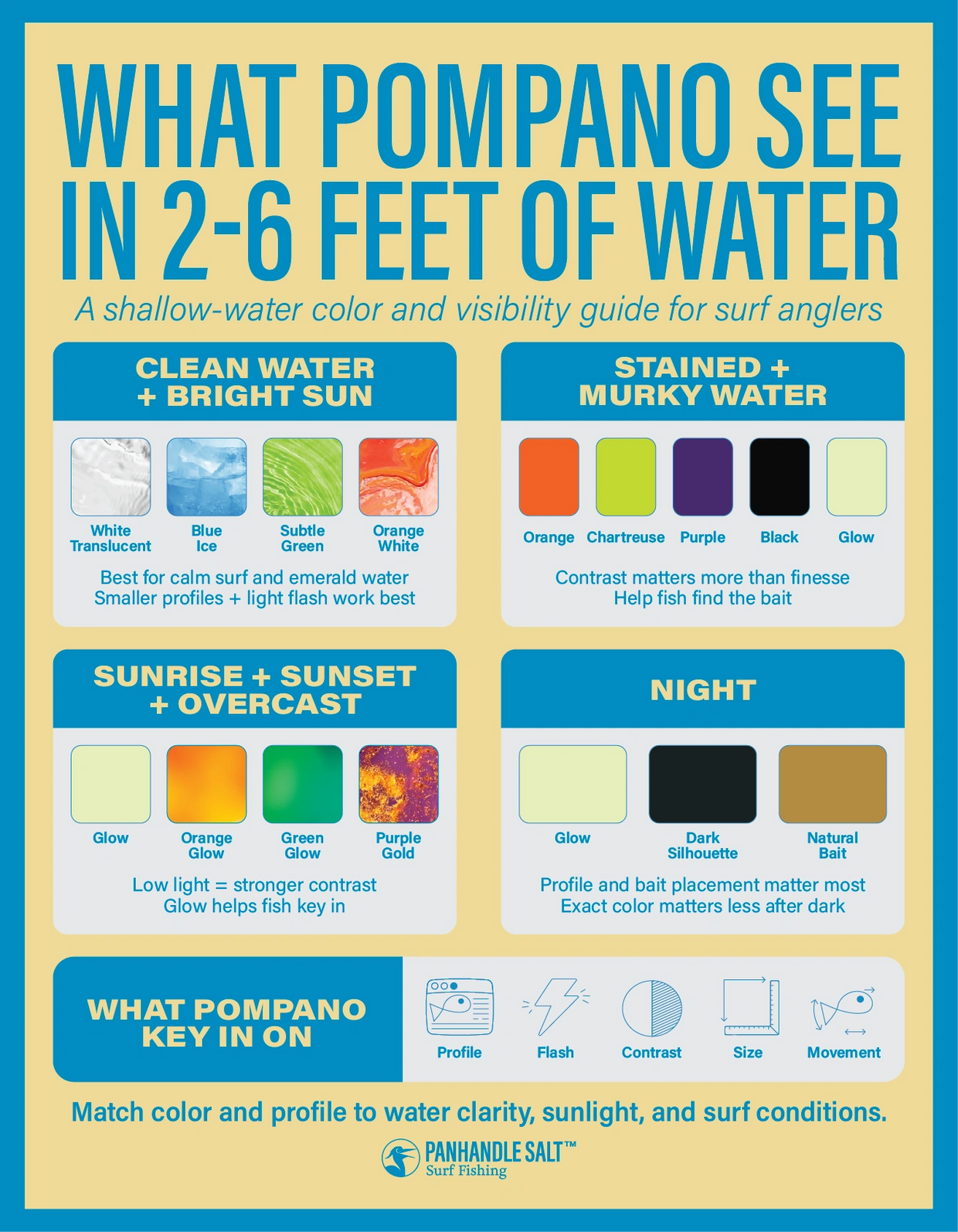
In Clear Water, Less is Often More
When the water is clean and the surf is calm, pompano can get a good look at what you’re throwing. That’s when I start thinking that a smaller profile, lighter leader, cleaner presentation, and less junk on the rig it is a good idea. If you’re fishing in 2–3 feet of water right off the sand, and the water looks like a swimming pool, a big loud double-drop with giant floats can be too much. That fish has time to inspect it, and that’s when things like translucent beads, white, blue, subtle green, smaller floats, and even naked hook start making a lot of sense. The cleaner the water gets, the more I want the rig to look like something edible, not a science project.
In Stained Water, Visibility Wins
Now flip the script. If the water has color to it, there’s chop on the surface, sand is suspended, and the fish don’t have as much visibility, I stop worrying as much about finesse and start thinking about visibility and contrast. That’s where colors like orange, chartreuse, purple, black, glow, and darker profiles can really shine. Not because pompano are down there saying, “Man, I sure love purple today", but because those colors help the fish find the bait. A lot of anglers get too caught up in “favorite colors.” What really matters is whether your offering stands out enough to be noticed in the conditions you are fishing.Clean water? Subtle can win. Dirty water? Sometimes you need to give them a bigger target.
Why Orange Works so Well
Orange is one of those colors that just keeps showing up in surf fishing, and for good reason. If pompano are feeding on sand fleas, then orange makes a lot of sense. You’re trying to mimic that little orange egg sac they see all the time in the wash. That’s why orange works in clear water, works in stained water
pairs well with almost everything, and flat-out catches fish.
Sometimes it’s about exact imitation and about giving them a color cue they already recognize as food. Either way, orange deserves its place in the surf.
Flash Matters More Than People Think
This is where bead cuts, reflective finishes, and certain float styles come in. In shallow water, sunlight bouncing through the surf can make flash do a lot of work. That little flicker of light coming off a faceted bead can look alive. It can make a fish turn. It can help scattered fish notice your rig from farther off.That’s why on bright days in emerald water, I like colors and materials that blend naturally but still kick off a little flash.
You don’t always need loud color if you’ve got the right amount of reflected light.
Sun Angle Changes Everything
Morning, midday, and afternoon are not the same. At sunup and sundown, the light is lower, softer, and coming in at an angle. That can make glow, orange, and stronger contrast colors stand out better. By midday, especially with bright skies and clean water, fish can usually get a much better look at the whole setup.
That’s why in the spring, when the water is right and pompano are active, you can often catch them all day long. They’re not just feeding because of the clock; they’re feeding because conditions let them do it comfortably.
What About Night?
At night, things change. Color starts to matter less, and things like silhouette, bait placement, scent, glow, and staying in the feeding lane matter more. If you’re fishing after dark, I’m not overthinking whether something is pink or green. I’m more focused on of is it visible, is it in the right zone, if it have scent, or if is it easy for a fish to find.
That’s where glow can really help. It gives fish something to key in on when there isn’t much light to work with.
Profile is Just as Important as Color
This might be the biggest takeaway in the whole blog. A lot of times, anglers spend all their time worrying about color and not enough time thinking about profile. If pompano are feeding on tiny fleas, little clams, or small pieces of forag, then your rig needs to make sense in that world. That means when the bite gets tough, or the water gets shallow and clear, I usually start downsizing to smaller floats, smaller beads, smaller bait pieces, lighter leaders, and less clutter.
That little shift can make a huge difference.A pompano that won’t touch a big flashy rig might eat a cleaner, smaller setup almost immediately.
So What do Pompano Really See?
In my opinion, pompano are not just seeing color.They are seeing a combination of shape, flash, contrast, size, movement, and how natural the whole package looks in the water they’re in.
That’s why there is no one “best” color. What works best is what fits the water clarity, the sunlight, the surf movement, the forage, and the mood of the fish.
Final Thought
If you want to become a better pompano angler, stop thinking only in terms of favorite colors and start thinking about what the fish can actually see that day.
*In clean water, tone it down.
*In dirty water, help them find it.
*In bright sun, let flash work for you.
*At low light, think contrast and glow.
*And when in doubt, make the whole rig look more natural, not more complicated.
APRIL AND MAY SURF FISHING ON THE GULF COAST: Pompano Run, Spanish Mackerel, and Spring Tactics
April and May are some of the hottest months on the beach along the Gulf Coast — and we’re not talking about temperature. We’re talking surf fishing hot. This is the stretch of the year that surf anglers in Northwest Florida live for. Pompano are in, tournaments are firing off all spring, coolers are getting heavy, and every trip to the sand feels like it could turn into one of those mornings you remember for a long time. This is The Pompano Run.

When the Water Hits the Right Number, It’s On
In our experience, once water temperatures start settling in around 70–72 degrees, things can change in a hurry. Pompano love that cooler, oxygen-rich surf water and will begin cruising the beaches in numbers and with purpose. They aren’t just randomly roaming either. They travel along the shoreline looking for clean water, active forage, and comfortable structure to feed around. This is also the time of year when you can catch pompano sunup to sundown.
In the colder months and the hotter months, a lot of the bite tends to center around first light, last light, and short feeding windows.
But in April and May, when conditions are right, pompano will stay active for much longer stretches of the day. That means you’re not just fishing a narrow bite window, you are fishing a full day pattern.
What Conditions Matter Most for Pompano?
A few things really stand out this time of year:
1. Clean Water. Pompano are primarily sight feeders. They want to be able to see what they’re eating. Clean, emerald-green water gives them the visibility they need to hunt comfortably. If the water is dirty, they can still bite, but when it gets clear and bright, the odds usually jump.
2. South Winds. A steady south or southeast wind often helps by:
*Pushing warmer Gulf water toward the beach
*Creating enough movement to stir up food
*Keeping the surf active without blowing it completely out
Too much wind can make it sloppy, but a manageable south push paired with decent clarity is usually a good sign.
3. Structure in the First Gut and Close Bars. A lot of anglers make the mistake of trying to throw everything to the moon this time of year. That is not always necessary.Some of the best fish in April and May are caught:
*In the first trough
*Along the inside edge of close sandbars
*In rips that are only 15–25 yards off the beach
These fish are often using the shallow zones to intercept sand fleas, coquina clams, and other forage being rolled around in the wash.
4. Lighter Tackle in the Close Zone. If you’re targeting pompano in skinny water, heavy tackle can work against you.In the close zone, we lean toward:
*15–20 lb leader
*Smaller beads or more subtle float profiles
*1–2 oz Sputniks when current allows
*Small bait profiles
Big floats and oversized rigs can spook fish in only a few feet of water. The goal is to give them something natural-looking that doesn’t overpower the zone.
Best Baits for April and May Pompano
This is the time of year when a lot of things can work, but the most productive baits are usually the ones fish are naturally seeing every day. Top choices include:
sand fleas, ghost shrimp, fresh shrimp, Fish Gum, and a combinations of natural bait and synthetic for scent + durability.
Bigger fish do not always want bigger baits. During the run, a smaller, cleaner presentation often outfishes a bulky one.
Late April into May: Here Come the Spanish
As we move deeper into late April and May, another fun shift starts happening. We begin seeing Spanish mackerel move into the surf.And once the Spanish show up, a lot of other warm-water activity isn’t far behind:
*Bluefish
*Jacks
*Big redfish
*Black drum
*Increased shark activity
This is when the beach really starts to come alive in multiple ways. You can soak bait for pompano and still have the option to spend part of the morning slinging lures into active water.
Why Sunrise Matters for Lure Fishing
If you want to target Spanish, blues, jacks, and other predators from shore, being on the beach at sunrise is a major advantage. Early light gives you:
*Lower-angle sun for spotting movement
*Cooler, calmer conditions
*Less beach traffic
*Better chances of predators pushing bait close
A good north wind is especially helpful for this style of fishing because it tends to:
*Lay the surf flatter
*Clean the water up
*Make it easier to see bait schools, nervous water, and predators working
On those calm mornings, you can literally sight fish from the beach.
What to Look for When Throwing Lures
When walking the beach with a lure rod, pay attention to nervous bait, swells or “rumbling” water, sudden flashes, birds dipping or hovering, and dark pushes moving down the beach. That rumbling water can mean a lot of things such as a school of jacks, dolphins pushing bait, bull reds, spanish blitzing glass minnows, or something bigger entirely. You won’t know until you fire a cast in there and see what happens.
Rod, Reel, and Line Setups for Spring Lure Fishing
For this style of fishing, we like rods that can cover water efficiently without wearing you out. Some of our favorites are the Assassin Rapid Spin Zero, Assassin Affinity, Assassin Spin Tech.
A solid reel setup would be a 3000 size Nautix with 15 lb Land Line braid.
That gives you enough line capacity, smooth casting, and enough drag for the fish you’re likely to encounter in the surf.
Matching Lure Weight to Rod Rating
This matters more than a lot of anglers realize. If your rod is rated:
*1–2 oz, a 1.5 oz lure is usually the sweet spot
*1–3 oz, a 2 oz lure is often ideal
Can you throw outside the exact middle? Sure. But if you want the rod to really load well, cast efficiently, and recover cleanly, staying near that sweet spot makes a big difference.
Mix It Up: Bait First, Lures Second
One of the best springtime plays is to split your effort. There are mornings when you can spend an hour throwing lures at sunrise, and switch over to bait rods for pompano once the beach settles into the day. That little one-hour session before work or before the family wakes up can be wildly productive this time of year.
New to Surf Fishing? We Can Help
If all of this sounds good but still feels overwhelming, that’s where we come in. At Panhandle Salt, we help anglers at all levels:
*New anglers learning from scratch
*Freshwater anglers adjusting to the surf
*Experienced surf anglers who want to sharpen their approach
We offer one-on-one surf fishing lessons to teach the core skills needed to be successful on the beach, including reading water, bait placement, tackle selection, rigging, and seasonal strategy
Planning a family vacation? We also run surf fishing charters for up to 4 people per guide. Got a large party? No problem. We can bring in more guides so everyone gets a real shot at pulling in what the Gulf has to offer.
Stop By the Shop
If you’ve got questions about setup, lures, rod pairings, braid, seasonal tactics, or what’s currently working, stop by the shop or shoot us an email. We’re here to help.
Spring on the Gulf Coast is too good to waste. Don’t spend all of it doing yard work. It can wait.
Pompano, Jigs, Lures & Spring Break
March 2nd, 2026
It’s here. Season. More specifically… pompano season. For the next three months, we can count on those delicious, hard-fighting, football-shaped fish to be on the dinner plate. March kicks it off, and it’s already showing signs of being a strong one.
Big Pompano Up Close
So far this year we’ve seen monster pompano caught up and down the Panhandle, with some real brutes coming out of Perdido Key. Our buddy Tony Faggioni landed a 5-pounder the last day of February in the Fort Pickens area and took first place in a tournament he’s fishing. Tony shared his take on what’s happening:
*With all the big pompano being caught, he thinks the breeders are done with their business in the bays.
*They’re starting to migrate out, using the passes and moving down the shoreline to feed.
*Most of the bigger fish are being caught in close.
That makes sense. They slide out of the bay through the passes, then cruise right along the beach for a meal.
I’ve said it time and time again: Don’t neglect the zone right off the sand.
Dialing in the “Right at Your Feet” Zone
If you’re fishing in 2–3 feet of water, you need to lighten up the tackle:
*Leader: 15–20 lb
*Sinker: 1 oz sputnik works great up close
*Rigs:
*Naked hooks or very small beads
*Avoid big, bright floats right in their face in skinny water
Big, bulky double-drops with large floats in shallow water will spook any fish that’s already a little skittish.
Bait Size Matters
Keep your bait small in this zone:
*Tiny sand fleas
*Small pieces of shrimp
*Smaller cuts of Fish Gum
There is a lot of opportunity right now to catch a once-in-a-lifetime pompano without ever bombing a cast past the bar.
March Means Pompano Jigging
March also kicks off pompano jigging season.Jigging is a fun, hands-on way to hook these seasonal fish, but I like to be strategic about when I do it.My rule of thumb:
Jig when you know you’re in a school.
How do you know you’re in a school?
*Your set lines start going off one after another
*You’re reeling in pompano over and over in a short window
Once that happens, you can set the sand-spike rods down for a minute and start throwing jigs into the same zone.
My Jigging Setup
Here’s what I like:
*Rod: 7'7" Super Nova by Assassin
*Rated 1/4–1 oz
*Stiff backbone with a fast tip – perfect for pompano jigs
*We also have 7'3" models with the same specs if you like something slightly shorter.
*Leader: 15–20 lb Perdido Leader tied to braid, and you’re in business.
It’s a lot easier to jig into an active school than it is to blind-cast for one fish that may or may not be there.
Lure Casting Time
ES, CID, GT Ice Cream & More. March also flips the switch for lure casting along the beach.Slinging ES Lures, CID Lures, and GT Ice Creams is a great way to spend a morning or afternoon when conditions are right.
Late March, you can run into:
*Bluefish
*Spanish mackerel
*Jacks
*Reds
*And even the occasional shark
Rods for Lure Work
For this kind of fishing, we recommend:
*9' Rapid Spin Zero (1–2 oz)
*11' Rapid Spin Zero (1–2 oz)
These rods will launch a 1.5 oz lure a mile off the beach.If you want to spoil yourself a bit, we also carry the 8'6" Assassin Affinity (1–3 oz). Upgraded stick, and able to handle those 2oz lures for the big boys.
Spring Break Crowds & Beach Etiquette
March also means spring break.
*Great for out-of-towners who’ve been waiting for the kids to get out of school
*Not so great for locals dealing with crowded beaches
During heavy traffic times, I avoid conflict by staying away from condo-heavy areas. We have plenty of open beach where you can fish without anyone around.But sometimes the best bite pulls you into more crowded zones. When that happens, remember your rights:
*As long as you’re on the wet sand, you are generally allowed to fish.
*The Shoreline Defender app is a great tool to show you exactly where you can and cannot set up.
We’ve had plenty of run-ins over the years. My advice:
*Stay calm
*Be respectful but firm
*When in doubt, call local law enforcement and let them sort it out
Nobody’s thrilled about walking out onto soft sand to referee, but so far I’ve always been sided with when I’m set up legally and reasonably.
Be Smart About Where You Set Up
Rights or not, use common sense:
*Don’t set up right next to swimmers or where families are clearly camping for the day
*Be aware of how and where you’re casting
*On crowded beaches people sneak up behind you fast
I make it a habit to look behind me before every cast. One quick glance can keep you from sticking a hook in someone’s face.
Final Thoughts
March is when everything wakes up:
*Pompano sliding in close
*Jigging turning on
*Lure casting coming alive
*Spring breakers filling in the gaps
Have fun, stay safe, respect the beach, and put some on the sand.I’ll see y’all out there.
Ghost Shrimp Pumping System. How to Find and Catch Ghost Shrimp
February 2nd, 2026
February is “Prep Month” at Panhandle Salt.
We still get those random warm days where we can sneak out and chase big fish, but for us, this short month before March is also when we reset for the season.
When the spring run hits, there’s no time to be digging around for gear, spooling reels, or tying rigs. February is when we handle all of that.
Here’s how we use this month—and how you can, too.
Tune-Up Time: Reels, Rigs, and Gear
February is when we go through every piece of gear and make sure it’s ready for the boom:
*Re-spool all reels: Old braid and mono get stripped, and fresh line goes on. If you had a rough fall or winter season, this is non-negotiable.
*Pre-tie dozens of rigs: Pompano, whiting, drum, and “Tough Bite” setups. We want a pile of rigs ready so when spring hits, we’re fishing—not sitting on the couch tying.
*Clean and grease components: Handles, drag knobs, bail arms, reel seats, rod guides—everything gets wiped down, checked, and greased where it matters.
*Declutter and inspect: We go through boxes, buckets, and bags and pull out anything rusty, worn down, or sketchy. Better to find it now than when you’re hooked up.
February is a great month to get a system in place so that once March rolls around, you’re ready to step on the gas.
February Is Ghost Shrimp Month
February is also one of the best times to hunt and prep ghost shrimp for the spring run. When you’ve got some downtime and decent weather, spend it scouting your local shorelines and looking for those magic patches of sand that hold them.
When to Look
From what we’ve seen lately, the best times have been:
*Low tide with little to no wind
*A few days before and after the new moon
*Neap tides can be great—lots of sand exposed and slower water
You want plenty of exposed sand and decent visibility. Wind has made it tough a few mornings, but when it calms down you can pump your heart out.
Pay special attention to points and slight bends in the beach. These spots usually have shallower water and subtle structure—perfect for ghost shrimp.
Keep an eye on your favorite fishing calendar or tide app and plan some February “exploration days” just for finding shrimp.
How We Preserve Ghost Shrimp
We’ve tried a lot of different ways to save ghost shrimp, and this is the method that has worked best for us.
1. Make a saturated brine solution
Mix salt and water in a pot and bring it up to where the water won’t hold any more salt (saturated brine).
Let that brine cool completely.
2. Soak the ghost shrimp
Once the brine is cool, soak your shrimp for about 20 minutes.
3. Dry and jar them
Pull the shrimp out of the brine and dry them really well.
Place the dried shrimp into an empty jar—no liquid.
4. Freeze them
Store the jar in the freezer with no liquid.
On fishing day, just pull out what you need and head to the beach.
For us, this has been the most effective way to preserve ghost shrimp and keep them usable for surf fishing. And believe me—we’ve tried just about everything.
Building a Simple Ghost Shrimp Sifter
If you’re going to pump ghost shrimp, a good sifter is worth its weight in gold. You can build a solid one with just a few items from the hardware and dollar store.
What You’ll Need
*4 PVC elbows – 3/4"
*6 feet of 3/4" PVC pipe – cut into four 1.5-foot pieces
*1 piece of 1/4" mesh – enough to cover the frame (buy a small roll; use the extra in your garden to keep critters off plants)
*2 pool noodles – from the dollar store
*Zip ties
*Rope – to tie to one corner and make a foot loop
How to Build It
1. Build the frame: Use the four 1.5' PVC pieces and the four elbows to make a rectangle or square frame.
2. Attach the mesh: Cut the 1/4" mesh to fit the frame.
Lay it over the frame and zip tie it on tight.
3. Add flotation
Cut the pool noodles to fit the sides of the frame.
Slice each piece down the middle so it can wrap over the PVC.
Slip them on and zip tie them in place. This keeps your sifter floating and easy to handle.
4. Add a foot loop
Tie a piece of rope to one corner and make a loop big enough for your foot.
On the beach, you can slide your foot through the loop so the sifter stays right beside you while you pump.
Don’t Skimp on the Pump
Last piece of the puzzle: buy a good ghost shrimp pump.
*Expect to spend around $100 for a solid one. In my opinion, it’s worth it.
*There are some PVC-style pumps made by Brunken Manufacturing that run around $60 and are decent options as well.
Grab a small bucket, your pump, and your sifter, and you’re in business: Pump shrimp → dump into sifter → repeat → take your catch home and start the brine process.
Don’t Waste February
Don’t let February just slide by. Use this month to:
*Prep your gear
*Dial in your rigs
*Scout ghost shrimp spots
*Build or upgrade your shrimp setup
*Stock the freezer and be ready for the spring pompano push
If you want help getting tuned up, we’d love to be part of your February prep.
*We offer surf fishing lessons and charters year-round in Perdido Key and Pensacola.
*We run a fully stocked surf fishing shop at the entrance of Johnson Beach, with rods, reels, rigs, bait, and all the gear you need for our local waters.
Come see us, ask questions, and let’s get you ready now—so when March hits, you’re not playing catch-up.
Winter Surf Fishing in Perdido Key: Snowbird Guide to Gear,
January 1st, 2025
If you’re spending the winter in Perdido Key, you are not in a bad spot. While a lot of people think surf fishing is only a spring and summer game, the Gulf doesn’t shut off in the winter—it just changes.
Winter is one of the best times for snowbirds to learn the surf, dial in their gear, and enjoy quiet beaches with fish still cruising the troughs. In this guide, we’ll walk through:
*The best winter species
*Rigs and gear that actually work here
*Bait choices for cold-water fish
*How to think about time of day, tide, and wind
*And how Panhandle Salt can help you fast-track the learning curve with lessons, rig-tying classes, and a fully stocked surf shop right at the entrance to Johnson Beach
What’s Biting in Winter?
You won’t see the same chaos as a spring pompano run, but winter has its own lineup of reliable surf species:
*Whiting (Gulf kingfish) – The winter MVP. These fish love the cooler water and are perfect table fare.
*Redfish – Slot and over-slot reds still cruise the surf, especially around structure and deeper cuts.
*Black drum – Often mixed in with reds, especially near deeper holes and around inshore structure.
*Sheepshead – Around jetties, rock, and structure, but you’ll see them near the passes and bridges too.
*Pompano (on warmer breaks) – Not as thick as spring, but you can still catch them on those warmer, stable-weather stretches.
*Bluefish & ladyfish – More hit-or-miss, but they’ll show when the bait pushes in.
The key in winter is not expecting a wide-open bite all day. It’s about timing and presentation.
Winter Rigs That Work on Perdido Key Beaches
You don’t need anything crazy. In fact, winter is a great time to simplify and tighten up your rigging.
1. Standard Two-Drop Surf RigYour bread-and-butter winter setup:
*Main line: 15–20 lb braid
*Leader: 15-20 lb mono or fluorocarbon
*Hooks: Size 1/0-2/0 circle or kahle hooks for whiting, pompano, and drum
*Sinker: 2–3 oz pyramid or sputnik, depending on current and wind
This rig will catch:
*Whiting
*Pompano
*Smaller drum and reds
*Random “bonus” fish
2. Bigger Bait Rig for Reds & DrumWhen you’re specifically targeting redfish and black drum:
*Leader: 20-30 lb mono
*Hook: 2/0–3/0 circle hook
*Sinker: 3–5 oz, depending on surf
*Bait: Larger peeled shrimp, fresh cut bait, or crab chunks when available
Fish this closer to cuts, deeper troughs, or near any structure you can reach from the sand.If all of this sounds like a foreign language, that’s exactly what we cover in our surf fishing lessons and rig-tying classes all winter long.
Top winter baits:
*Fresh shrimp – Peeled or cut into small chunks for whiting, pompano, and drum.
*Fish Gum / artificial strips – Great for back-up and scent attractant.
*Sand fleas (mole crabs) – If you can find them, pompano and whiting will still eat them.
*Blue Crab or Fiddler Crabs– When you’re targeting drum or sheepshead around structure.
Winter tip: Downsize your bait. Smaller pieces in colder water often out-fish big chunks.
Time of Day: When Should Snowbirds Hit the Beach?
In the heat of summer, a lot of anglers love dawn and dusk. In winter, that changes a bit.
*Mid-morning to early afternoon can be the sweet spot.
*The sun has had time to warm the shallows just a few degrees.
*Fish that were sluggish at first light often start sliding into the troughs to feed.
If you’re a snowbird, this is good news: You don’t have to be on the beach at 5:00 a.m. to have a good day.
Reading Tide & Water Movement in Winter
You don’t need a fancy tide theory degree. Just remember:
*Moving water = life.
*Aim to fish the two hours before and after a tide change.
*Incoming tide often brings cleaner, slightly warmer water into the surf.
*Watch for visible cuts and deeper darker water between sandbars—that’s where your rigs should land.
If you’ve ever stared at the Gulf and thought, “I have no idea where to cast,” that’s one of the main things we break down in our lessons on the beach.

Learn Faster: Winter Surf Fishing Lessons & Rig-Tying Classes
If you’re a snowbird here for a month—or the whole season—winter is the perfect time to get some focused instruction before spring crowds and spring fish show up.
At Panhandle Salt Surf Fishing, we offer Surf Fishing Lessons (All Winter Long)
*One-on-one sessions or couples
*Held right on the beach
We cover:
*Reading the surf
*Where and how to set your rods
*Casting longer surf rods correctly
*Matching rigs and bait to our local conditions and much more
Rig-Tying Classes
*Learn to tie your own pompano and whiting rigs
*Understand hook sizes, leader choices, and sinkers
*Save money long term and trust your own gear
Fully Stocked Surf Shop at Johnson Beach
We also run a fully stocked surf fishing shop right at the entrance to Johnson Beach on Perdido Key. You’ll find:
*Surf rods and reels suited for our Gulf conditions
*Pre-tied rigs and leader material
*Sinkers, Fish Gum, terminal tackle
*Bait options and local advice you’re not getting from a big-box store
You can step out of the shop, look at the water, and we’ll talk you through exactly how we’d fish it that day.
Wind: Friend or Enemy?
Winter winds along the Gulf can make or break a surf fishing
*Light north or northwest winds often mean cleaner, calmer water along Perdido Key. Great for whiting, and sight-fishing the troughs.
*Strong east or west winds can stack waves and push weed or dirty water down the beach. Drum tend to roam in dirty wat
Ready to Make the Most of Your Winter?
If you’re down here escaping the snow and looking at that blue water thinking, “I’d love to learn this,” winter is your window.
*Quiet beaches
*Cooperative winter species
*Time to learn without pressure
Book a surf fishing lesson, sit in on a rig-tying class, or stop by the shop at the entrance of Johnson Beach and let’s get you dialed in.By the time March rolls around and the pompano run fires up, you won’t be starting from scratch—you’ll be ready to put fish in the cooler.