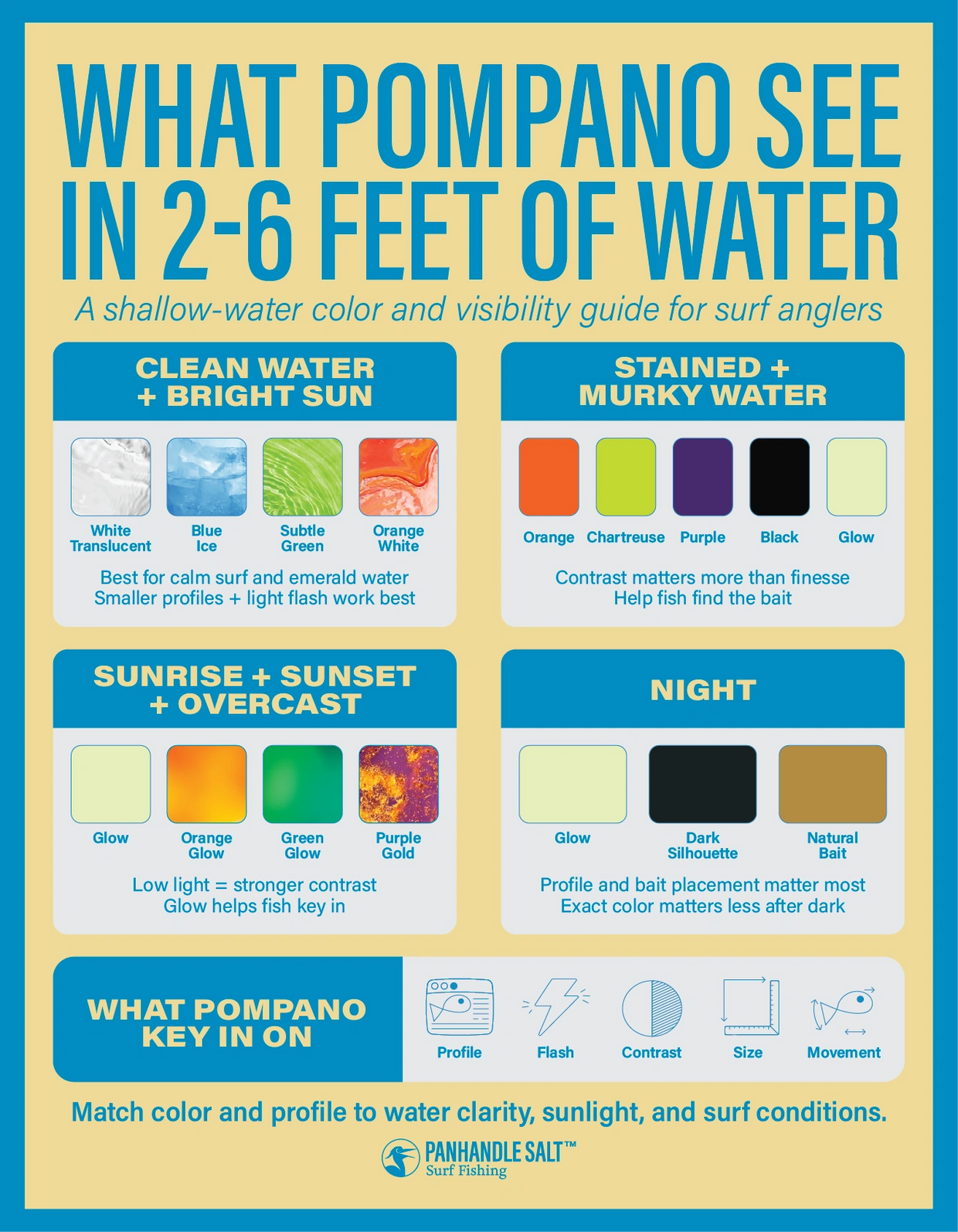
In Clear Water, Less is Often More
When the water is clean and the surf is calm, pompano can get a good look at what you’re throwing. That’s when I start thinking that a smaller profile, lighter leader, cleaner presentation, and less junk on the rig it is a good idea. If you’re fishing in 2–3 feet of water right off the sand, and the water looks like a swimming pool, a big loud double-drop with giant floats can be too much. That fish has time to inspect it, and that’s when things like translucent beads, white, blue, subtle green, smaller floats, and even naked hook start making a lot of sense. The cleaner the water gets, the more I want the rig to look like something edible, not a science project.

In Stained Water, Visibility Wins
Now flip the script. If the water has color to it, there’s chop on the surface, sand is suspended, and the fish don’t have as much visibility, I stop worrying as much about finesse and start thinking about visibility and contrast. That’s where colors like orange, chartreuse, purple, black, glow, and darker profiles can really shine. Not because pompano are down there saying, “Man, I sure love purple today", but because those colors help the fish find the bait. A lot of anglers get too caught up in “favorite colors.” What really matters is whether your offering stands out enough to be noticed in the conditions you are fishing.Clean water? Subtle can win. Dirty water? Sometimes you need to give them a bigger target.
Why Orange Works so Well
Orange is one of those colors that just keeps showing up in surf fishing, and for good reason. If pompano are feeding on sand fleas, then orange makes a lot of sense. You’re trying to mimic that little orange egg sac they see all the time in the wash. That’s why orange works in clear water, works in stained water
pairs well with almost everything, and flat-out catches fish.
Sometimes it’s about exact imitation and about giving them a color cue they already recognize as food. Either way, orange deserves its place in the surf.
Flash Matters More Than People Think
This is where bead cuts, reflective finishes, and certain float styles come in. In shallow water, sunlight bouncing through the surf can make flash do a lot of work. That little flicker of light coming off a faceted bead can look alive. It can make a fish turn. It can help scattered fish notice your rig from farther off.That’s why on bright days in emerald water, I like colors and materials that blend naturally but still kick off a little flash.
You don’t always need loud color if you’ve got the right amount of reflected light.
Sun Angle Changes Everything
Morning, midday, and afternoon are not the same. At sunup and sundown, the light is lower, softer, and coming in at an angle. That can make glow, orange, and stronger contrast colors stand out better. By midday, especially with bright skies and clean water, fish can usually get a much better look at the whole setup.
That’s why in the spring, when the water is right and pompano are active, you can often catch them all day long. They’re not just feeding because of the clock; they’re feeding because conditions let them do it comfortably.
What About Night?
At night, things change. Color starts to matter less, and things like silhouette, bait placement, scent, glow, and staying in the feeding lane matter more. If you’re fishing after dark, I’m not overthinking whether something is pink or green. I’m more focused on of is it visible, is it in the right zone, if it have scent, or if is it easy for a fish to find.
That’s where glow can really help. It gives fish something to key in on when there isn’t much light to work with.

Profile is Just as Important as Color
This might be the biggest takeaway in the whole blog. A lot of times, anglers spend all their time worrying about color and not enough time thinking about profile. If pompano are feeding on tiny fleas, little clams, or small pieces of forag, then your rig needs to make sense in that world. That means when the bite gets tough, or the water gets shallow and clear, I usually start downsizing to smaller floats, smaller beads, smaller bait pieces, lighter leaders, and less clutter.
That little shift can make a huge difference.A pompano that won’t touch a big flashy rig might eat a cleaner, smaller setup almost immediately.
So What do Pompano Really See?
In my opinion, pompano are not just seeing color.They are seeing a combination of shape, flash, contrast, size, movement, and how natural the whole package looks in the water they’re in.
That’s why there is no one “best” color. What works best is what fits the water clarity, the sunlight, the surf movement, the forage, and the mood of the fish.
Final Thought
If you want to become a better pompano angler, stop thinking only in terms of favorite colors and start thinking about what the fish can actually see that day.
*In clean water, tone it down.
*In dirty water, help them find it.
*In bright sun, let flash work for you.
*At low light, think contrast and glow.
*And when in doubt, make the whole rig look more natural, not more complicated.
APRIL AND MAY SURF FISHING ON THE GULF COAST: Pompano Run, Spanish Mackerel, and Spring Tactics
April and May are some of the hottest months on the beach along the Gulf Coast — and we’re not talking about temperature. We’re talking surf fishing hot. This is the stretch of the year that surf anglers in Northwest Florida live for. Pompano are in, tournaments are firing off all spring, coolers are getting heavy, and every trip to the sand feels like it could turn into one of those mornings you remember for a long time. This is The Pompano Run.

When the Water Hits the Right Number, It’s On
In our experience, once water temperatures start settling in around 70–72 degrees, things can change in a hurry. Pompano love that cooler, oxygen-rich surf water and will begin cruising the beaches in numbers and with purpose. They aren’t just randomly roaming either. They travel along the shoreline looking for clean water, active forage, and comfortable structure to feed around. This is also the time of year when you can catch pompano sunup to sundown.
In the colder months and the hotter months, a lot of the bite tends to center around first light, last light, and short feeding windows.
But in April and May, when conditions are right, pompano will stay active for much longer stretches of the day. That means you’re not just fishing a narrow bite window, you are fishing a full day pattern.
What Conditions Matter Most for Pompano?
A few things really stand out this time of year:
1. Clean Water. Pompano are primarily sight feeders. They want to be able to see what they’re eating. Clean, emerald-green water gives them the visibility they need to hunt comfortably. If the water is dirty, they can still bite, but when it gets clear and bright, the odds usually jump.
2. South Winds. A steady south or southeast wind often helps by:
*Pushing warmer Gulf water toward the beach
*Creating enough movement to stir up food
*Keeping the surf active without blowing it completely out
Too much wind can make it sloppy, but a manageable south push paired with decent clarity is usually a good sign.
3. Structure in the First Gut and Close Bars. A lot of anglers make the mistake of trying to throw everything to the moon this time of year. That is not always necessary.Some of the best fish in April and May are caught:
*In the first trough
*Along the inside edge of close sandbars
*In rips that are only 15–25 yards off the beach
These fish are often using the shallow zones to intercept sand fleas, coquina clams, and other forage being rolled around in the wash.
4. Lighter Tackle in the Close Zone. If you’re targeting pompano in skinny water, heavy tackle can work against you.In the close zone, we lean toward:
*15–20 lb leader
*Smaller beads or more subtle float profiles
*1–2 oz Sputniks when current allows
*Small bait profiles
Big floats and oversized rigs can spook fish in only a few feet of water. The goal is to give them something natural-looking that doesn’t overpower the zone.
Best Baits for April and May Pompano
This is the time of year when a lot of things can work, but the most productive baits are usually the ones fish are naturally seeing every day. Top choices include:
sand fleas, ghost shrimp, fresh shrimp, Fish Gum, and a combinations of natural bait and synthetic for scent + durability.
Bigger fish do not always want bigger baits. During the run, a smaller, cleaner presentation often outfishes a bulky one.
Late April into May: Here Come the Spanish
As we move deeper into late April and May, another fun shift starts happening. We begin seeing Spanish mackerel move into the surf.And once the Spanish show up, a lot of other warm-water activity isn’t far behind:
*Bluefish
*Jacks
*Big redfish
*Black drum
*Increased shark activity
This is when the beach really starts to come alive in multiple ways. You can soak bait for pompano and still have the option to spend part of the morning slinging lures into active water.
Why Sunrise Matters for Lure Fishing
If you want to target Spanish, blues, jacks, and other predators from shore, being on the beach at sunrise is a major advantage. Early light gives you:
*Lower-angle sun for spotting movement
*Cooler, calmer conditions
*Less beach traffic
*Better chances of predators pushing bait close
A good north wind is especially helpful for this style of fishing because it tends to:
*Lay the surf flatter
*Clean the water up
*Make it easier to see bait schools, nervous water, and predators working
On those calm mornings, you can literally sight fish from the beach.
What to Look for When Throwing Lures
When walking the beach with a lure rod, pay attention to nervous bait, swells or “rumbling” water, sudden flashes, birds dipping or hovering, and dark pushes moving down the beach. That rumbling water can mean a lot of things such as a school of jacks, dolphins pushing bait, bull reds, spanish blitzing glass minnows, or something bigger entirely. You won’t know until you fire a cast in there and see what happens.
Rod, Reel, and Line Setups for Spring Lure Fishing
For this style of fishing, we like rods that can cover water efficiently without wearing you out. Some of our favorites are the Assassin Rapid Spin Zero, Assassin Affinity, Assassin Spin Tech.
A solid reel setup would be a 3000 size Nautix with 15 lb Land Line braid.
That gives you enough line capacity, smooth casting, and enough drag for the fish you’re likely to encounter in the surf.
Matching Lure Weight to Rod Rating
This matters more than a lot of anglers realize. If your rod is rated:
*1–2 oz, a 1.5 oz lure is usually the sweet spot
*1–3 oz, a 2 oz lure is often ideal
Can you throw outside the exact middle? Sure. But if you want the rod to really load well, cast efficiently, and recover cleanly, staying near that sweet spot makes a big difference.
Mix It Up: Bait First, Lures Second
One of the best springtime plays is to split your effort. There are mornings when you can spend an hour throwing lures at sunrise, and switch over to bait rods for pompano once the beach settles into the day. That little one-hour session before work or before the family wakes up can be wildly productive this time of year.

New to Surf Fishing? We Can Help
If all of this sounds good but still feels overwhelming, that’s where we come in. At Panhandle Salt, we help anglers at all levels:
*New anglers learning from scratch
*Freshwater anglers adjusting to the surf
*Experienced surf anglers who want to sharpen their approach
We offer one-on-one surf fishing lessons to teach the core skills needed to be successful on the beach, including reading water, bait placement, tackle selection, rigging, and seasonal strategy
Planning a family vacation? We also run surf fishing charters for up to 4 people per guide. Got a large party? No problem. We can bring in more guides so everyone gets a real shot at pulling in what the Gulf has to offer.
Stop By the Shop
If you’ve got questions about setup, lures, rod pairings, braid, seasonal tactics, or what’s currently working, stop by the shop or shoot us an email. We’re here to help.
Spring on the Gulf Coast is too good to waste. Don’t spend all of it doing yard work. It can wait.
Pompano, Jigs, Lures & Spring Break
March 2nd, 2026
It’s here. Season. More specifically… pompano season. For the next three months, we can count on those delicious, hard-fighting, football-shaped fish to be on the dinner plate. March kicks it off, and it’s already showing signs of being a strong one.
Big Pompano Up Close
So far this year we’ve seen monster pompano caught up and down the Panhandle, with some real brutes coming out of Perdido Key. Our buddy Tony Faggioni landed a 5-pounder the last day of February in the Fort Pickens area and took first place in a tournament he’s fishing. Tony shared his take on what’s happening:
*With all the big pompano being caught, he thinks the breeders are done with their business in the bays.
*They’re starting to migrate out, using the passes and moving down the shoreline to feed.
*Most of the bigger fish are being caught in close.
That makes sense. They slide out of the bay through the passes, then cruise right along the beach for a meal.
I’ve said it time and time again: Don’t neglect the zone right off the sand.
Dialing in the “Right at Your Feet” Zone
If you’re fishing in 2–3 feet of water, you need to lighten up the tackle:
*Leader: 15–20 lb
*Sinker: 1 oz sputnik works great up close
*Rigs:
*Naked hooks or very small beads
*Avoid big, bright floats right in their face in skinny water
Big, bulky double-drops with large floats in shallow water will spook any fish that’s already a little skittish.
Bait Size Matters
Keep your bait small in this zone:
*Tiny sand fleas
*Small pieces of shrimp
*Smaller cuts of Fish Gum
There is a lot of opportunity right now to catch a once-in-a-lifetime pompano without ever bombing a cast past the bar.
March Means Pompano Jigging
March also kicks off pompano jigging season.Jigging is a fun, hands-on way to hook these seasonal fish, but I like to be strategic about when I do it.My rule of thumb:
Jig when you know you’re in a school.
How do you know you’re in a school?
*Your set lines start going off one after another
*You’re reeling in pompano over and over in a short window
Once that happens, you can set the sand-spike rods down for a minute and start throwing jigs into the same zone.
My Jigging Setup
Here’s what I like:
*Rod: 7'7" Super Nova by Assassin
*Rated 1/4–1 oz
*Stiff backbone with a fast tip – perfect for pompano jigs
*We also have 7'3" models with the same specs if you like something slightly shorter.
*Leader: 15–20 lb Perdido Leader tied to braid, and you’re in business.
It’s a lot easier to jig into an active school than it is to blind-cast for one fish that may or may not be there.
Lure Casting Time
ES, CID, GT Ice Cream & More. March also flips the switch for lure casting along the beach.Slinging ES Lures, CID Lures, and GT Ice Creams is a great way to spend a morning or afternoon when conditions are right.
Late March, you can run into:
*Bluefish
*Spanish mackerel
*Jacks
*Reds
*And even the occasional shark
Rods for Lure Work
For this kind of fishing, we recommend:
*9' Rapid Spin Zero (1–2 oz)
*11' Rapid Spin Zero (1–2 oz)
These rods will launch a 1.5 oz lure a mile off the beach.If you want to spoil yourself a bit, we also carry the 8'6" Assassin Affinity (1–3 oz). Upgraded stick, and able to handle those 2oz lures for the big boys.
Spring Break Crowds & Beach Etiquette
March also means spring break.
*Great for out-of-towners who’ve been waiting for the kids to get out of school
*Not so great for locals dealing with crowded beaches
During heavy traffic times, I avoid conflict by staying away from condo-heavy areas. We have plenty of open beach where you can fish without anyone around.But sometimes the best bite pulls you into more crowded zones. When that happens, remember your rights:
*As long as you’re on the wet sand, you are generally allowed to fish.
*The Shoreline Defender app is a great tool to show you exactly where you can and cannot set up.
We’ve had plenty of run-ins over the years. My advice:
*Stay calm
*Be respectful but firm
*When in doubt, call local law enforcement and let them sort it out
Nobody’s thrilled about walking out onto soft sand to referee, but so far I’ve always been sided with when I’m set up legally and reasonably.
Be Smart About Where You Set Up
Rights or not, use common sense:
*Don’t set up right next to swimmers or where families are clearly camping for the day
*Be aware of how and where you’re casting
*On crowded beaches people sneak up behind you fast
I make it a habit to look behind me before every cast. One quick glance can keep you from sticking a hook in someone’s face.
Final Thoughts
March is when everything wakes up:
*Pompano sliding in close
*Jigging turning on
*Lure casting coming alive
*Spring breakers filling in the gaps
Have fun, stay safe, respect the beach, and put some on the sand.I’ll see y’all out there.
Ghost Shrimp Pumping System. How to Find and Catch Ghost Shrimp
February 2nd, 2026
February is “Prep Month” at Panhandle Salt.
We still get those random warm days where we can sneak out and chase big fish, but for us, this short month before March is also when we reset for the season.
When the spring run hits, there’s no time to be digging around for gear, spooling reels, or tying rigs. February is when we handle all of that.
Here’s how we use this month—and how you can, too.
Tune-Up Time: Reels, Rigs, and Gear
February is when we go through every piece of gear and make sure it’s ready for the boom:
*Re-spool all reels: Old braid and mono get stripped, and fresh line goes on. If you had a rough fall or winter season, this is non-negotiable.
*Pre-tie dozens of rigs: Pompano, whiting, drum, and “Tough Bite” setups. We want a pile of rigs ready so when spring hits, we’re fishing—not sitting on the couch tying.
*Clean and grease components: Handles, drag knobs, bail arms, reel seats, rod guides—everything gets wiped down, checked, and greased where it matters.
*Declutter and inspect: We go through boxes, buckets, and bags and pull out anything rusty, worn down, or sketchy. Better to find it now than when you’re hooked up.
February is a great month to get a system in place so that once March rolls around, you’re ready to step on the gas.
February Is Ghost Shrimp Month
February is also one of the best times to hunt and prep ghost shrimp for the spring run. When you’ve got some downtime and decent weather, spend it scouting your local shorelines and looking for those magic patches of sand that hold them.
When to Look
From what we’ve seen lately, the best times have been:
*Low tide with little to no wind
*A few days before and after the new moon
*Neap tides can be great—lots of sand exposed and slower water
You want plenty of exposed sand and decent visibility. Wind has made it tough a few mornings, but when it calms down you can pump your heart out.
Pay special attention to points and slight bends in the beach. These spots usually have shallower water and subtle structure—perfect for ghost shrimp.
Keep an eye on your favorite fishing calendar or tide app and plan some February “exploration days” just for finding shrimp.
How We Preserve Ghost Shrimp
We’ve tried a lot of different ways to save ghost shrimp, and this is the method that has worked best for us.
1. Make a saturated brine solution
Mix salt and water in a pot and bring it up to where the water won’t hold any more salt (saturated brine).
Let that brine cool completely.
2. Soak the ghost shrimp
Once the brine is cool, soak your shrimp for about 20 minutes.
3. Dry and jar them
Pull the shrimp out of the brine and dry them really well.
Place the dried shrimp into an empty jar—no liquid.
4. Freeze them
Store the jar in the freezer with no liquid.
On fishing day, just pull out what you need and head to the beach.
For us, this has been the most effective way to preserve ghost shrimp and keep them usable for surf fishing. And believe me—we’ve tried just about everything.
Building a Simple Ghost Shrimp Sifter
If you’re going to pump ghost shrimp, a good sifter is worth its weight in gold. You can build a solid one with just a few items from the hardware and dollar store.
What You’ll Need
*4 PVC elbows – 3/4"
*6 feet of 3/4" PVC pipe – cut into four 1.5-foot pieces
*1 piece of 1/4" mesh – enough to cover the frame (buy a small roll; use the extra in your garden to keep critters off plants)
*2 pool noodles – from the dollar store
*Zip ties
*Rope – to tie to one corner and make a foot loop
How to Build It
1. Build the frame: Use the four 1.5' PVC pieces and the four elbows to make a rectangle or square frame.
2. Attach the mesh: Cut the 1/4" mesh to fit the frame.
Lay it over the frame and zip tie it on tight.
3. Add flotation
Cut the pool noodles to fit the sides of the frame.
Slice each piece down the middle so it can wrap over the PVC.
Slip them on and zip tie them in place. This keeps your sifter floating and easy to handle.
4. Add a foot loop
Tie a piece of rope to one corner and make a loop big enough for your foot.
On the beach, you can slide your foot through the loop so the sifter stays right beside you while you pump.
Don’t Skimp on the Pump
Last piece of the puzzle: buy a good ghost shrimp pump.
*Expect to spend around $100 for a solid one. In my opinion, it’s worth it.
*There are some PVC-style pumps made by Brunken Manufacturing that run around $60 and are decent options as well.
Grab a small bucket, your pump, and your sifter, and you’re in business: Pump shrimp → dump into sifter → repeat → take your catch home and start the brine process.
Don’t Waste February
Don’t let February just slide by. Use this month to:
*Prep your gear
*Dial in your rigs
*Scout ghost shrimp spots
*Build or upgrade your shrimp setup
*Stock the freezer and be ready for the spring pompano push
If you want help getting tuned up, we’d love to be part of your February prep.
*We offer surf fishing lessons and charters year-round in Perdido Key and Pensacola.
*We run a fully stocked surf fishing shop at the entrance of Johnson Beach, with rods, reels, rigs, bait, and all the gear you need for our local waters.
Come see us, ask questions, and let’s get you ready now—so when March hits, you’re not playing catch-up.
Winter Surf Fishing in Perdido Key: Snowbird Guide to Gear,
January 1st, 2025
If you’re spending the winter in Perdido Key, you are not in a bad spot. While a lot of people think surf fishing is only a spring and summer game, the Gulf doesn’t shut off in the winter—it just changes.
Winter is one of the best times for snowbirds to learn the surf, dial in their gear, and enjoy quiet beaches with fish still cruising the troughs. In this guide, we’ll walk through:
*The best winter species
*Rigs and gear that actually work here
*Bait choices for cold-water fish
*How to think about time of day, tide, and wind
*And how Panhandle Salt can help you fast-track the learning curve with lessons, rig-tying classes, and a fully stocked surf shop right at the entrance to Johnson Beach
What’s Biting in Winter?
You won’t see the same chaos as a spring pompano run, but winter has its own lineup of reliable surf species:
*Whiting (Gulf kingfish) – The winter MVP. These fish love the cooler water and are perfect table fare.
*Redfish – Slot and over-slot reds still cruise the surf, especially around structure and deeper cuts.
*Black drum – Often mixed in with reds, especially near deeper holes and around inshore structure.
*Sheepshead – Around jetties, rock, and structure, but you’ll see them near the passes and bridges too.
*Pompano (on warmer breaks) – Not as thick as spring, but you can still catch them on those warmer, stable-weather stretches.
*Bluefish & ladyfish – More hit-or-miss, but they’ll show when the bait pushes in.
The key in winter is not expecting a wide-open bite all day. It’s about timing and presentation.
Winter Rigs That Work on Perdido Key Beaches
You don’t need anything crazy. In fact, winter is a great time to simplify and tighten up your rigging.
1. Standard Two-Drop Surf RigYour bread-and-butter winter setup:
*Main line: 15–20 lb braid
*Leader: 15-20 lb mono or fluorocarbon
*Hooks: Size 1/0-2/0 circle or kahle hooks for whiting, pompano, and drum
*Sinker: 2–3 oz pyramid or sputnik, depending on current and wind
This rig will catch:
*Whiting
*Pompano
*Smaller drum and reds
*Random “bonus” fish
2. Bigger Bait Rig for Reds & DrumWhen you’re specifically targeting redfish and black drum:
*Leader: 20-30 lb mono
*Hook: 2/0–3/0 circle hook
*Sinker: 3–5 oz, depending on surf
*Bait: Larger peeled shrimp, fresh cut bait, or crab chunks when available
Fish this closer to cuts, deeper troughs, or near any structure you can reach from the sand.If all of this sounds like a foreign language, that’s exactly what we cover in our surf fishing lessons and rig-tying classes all winter long.
Top winter baits:
*Fresh shrimp – Peeled or cut into small chunks for whiting, pompano, and drum.
*Fish Gum / artificial strips – Great for back-up and scent attractant.
*Sand fleas (mole crabs) – If you can find them, pompano and whiting will still eat them.
*Blue Crab or Fiddler Crabs– When you’re targeting drum or sheepshead around structure.
Winter tip: Downsize your bait. Smaller pieces in colder water often out-fish big chunks.
Time of Day: When Should Snowbirds Hit the Beach?
In the heat of summer, a lot of anglers love dawn and dusk. In winter, that changes a bit.
*Mid-morning to early afternoon can be the sweet spot.
*The sun has had time to warm the shallows just a few degrees.
*Fish that were sluggish at first light often start sliding into the troughs to feed.
If you’re a snowbird, this is good news: You don’t have to be on the beach at 5:00 a.m. to have a good day.
Reading Tide & Water Movement in Winter
You don’t need a fancy tide theory degree. Just remember:
*Moving water = life.
*Aim to fish the two hours before and after a tide change.
*Incoming tide often brings cleaner, slightly warmer water into the surf.
*Watch for visible cuts and deeper darker water between sandbars—that’s where your rigs should land.
If you’ve ever stared at the Gulf and thought, “I have no idea where to cast,” that’s one of the main things we break down in our lessons on the beach.

Learn Faster: Winter Surf Fishing Lessons & Rig-Tying Classes
If you’re a snowbird here for a month—or the whole season—winter is the perfect time to get some focused instruction before spring crowds and spring fish show up.
At Panhandle Salt Surf Fishing, we offer Surf Fishing Lessons (All Winter Long)
*One-on-one sessions or couples
*Held right on the beach
We cover:
*Reading the surf
*Where and how to set your rods
*Casting longer surf rods correctly
*Matching rigs and bait to our local conditions and much more
Rig-Tying Classes
*Learn to tie your own pompano and whiting rigs
*Understand hook sizes, leader choices, and sinkers
*Save money long term and trust your own gear
Fully Stocked Surf Shop at Johnson Beach
We also run a fully stocked surf fishing shop right at the entrance to Johnson Beach on Perdido Key. You’ll find:
*Surf rods and reels suited for our Gulf conditions
*Pre-tied rigs and leader material
*Sinkers, Fish Gum, terminal tackle
*Bait options and local advice you’re not getting from a big-box store
You can step out of the shop, look at the water, and we’ll talk you through exactly how we’d fish it that day.
Wind: Friend or Enemy?
Winter winds along the Gulf can make or break a surf fishing
*Light north or northwest winds often mean cleaner, calmer water along Perdido Key. Great for whiting, and sight-fishing the troughs.
*Strong east or west winds can stack waves and push weed or dirty water down the beach. Drum tend to roam in dirty wat
Ready to Make the Most of Your Winter?
If you’re down here escaping the snow and looking at that blue water thinking, “I’d love to learn this,” winter is your window.
*Quiet beaches
*Cooperative winter species
*Time to learn without pressure
Book a surf fishing lesson, sit in on a rig-tying class, or stop by the shop at the entrance of Johnson Beach and let’s get you dialed in.By the time March rolls around and the pompano run fires up, you won’t be starting from scratch—you’ll be ready to put fish in the cooler.